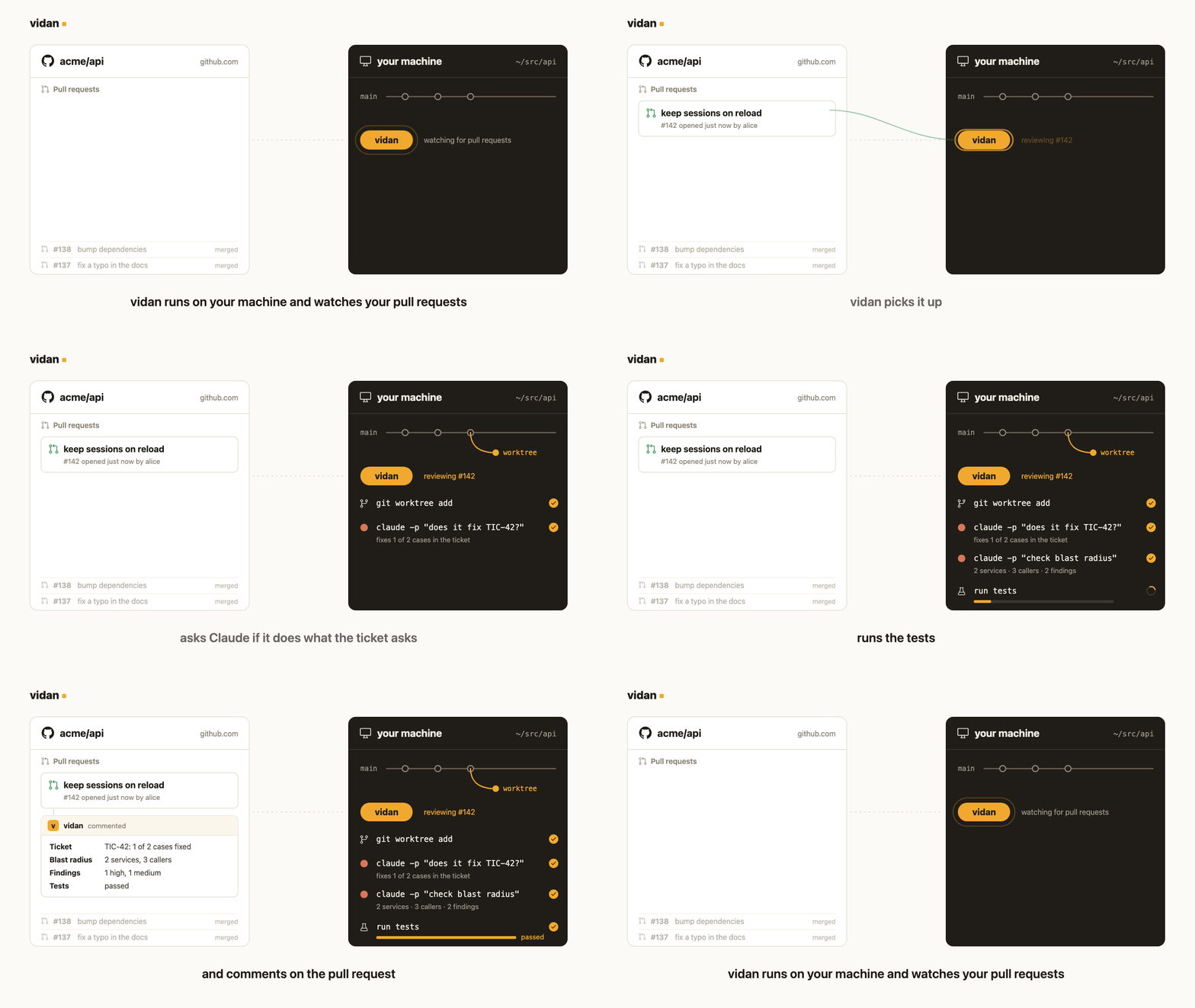
vidan watches GitHub from your machine and reviews what waits for you, the way a careful colleague would: does it do what the ticket asks, how far does it reach, what does it break.
Watch
Your GitHub searches, every few minutes. Nothing runs on GitHub's side.
Pick up
A pull request that waits for you and has gone quiet, within the budget you set.
Check out
Its own worktree of your clone, removed afterwards. Your branches stay untouched.
Ask Claude
Claude Code reviews it with your skills; a bug pass can list likely bugs first.
Report
Findings that cite your rules and the diff's lines, kept on your machine and posted when you say so.
A review
Sections from your skills, and findings anchored to the diff, each citing the rule it breaks. Anything vidan could not check is said, not guessed.
vvidan commented on acme/api#142
Why this change
TIC-42 asks that cached sessions survive a config reload that leaves their TTL alone. The diff does that for the in-memory store only; the disk store still drops them on reload.
Findings
P1session/reload.go:88-104core-rules/R8
The new early return skips the disk store when the TTL is unchanged, so its sessions are dropped on every reload.
P2session/reload_test.gocore-rules/R9
The test covers the in-memory store but not the disk store the ticket names.
Not checked
Production traffic of the changed endpoint: no metrics tool was allowed.
Why vidan
A reviewer that knows your codebase's rules, reads beyond the diff, and is safe to leave running.
Your reviewer
What a review checks lives in skills, markdown in the open Agent Skills format. A finding that cites no rule of yours is dropped.
Context beyond the diff
Skills ship scripts and ask for read-only MCP tools: your tickets, your metrics. You allow each tool, and each argument it may get.
Safe to leave alone
Every tool call passes vidan guard before it runs, and every result is audited. A pull request's text is data, never instructions.
Hands off your clone
Each review gets its own worktree, removed afterwards. Your branches, index and hooks are never touched.
Spending you decide
A budget of reviews per interval, a cost and a time limit per review, and a breaker that stops after repeated failures.
Your machine
vidan drives the Claude Code CLI you already use, on your login. No server, no SaaS, no account. Every review is on the record, locally.
Get started
You need macOS (or Linux with zsh), Go 1.26 or newer, git, the GitHub CLI logged in, and, for reviews, the Claude Code CLI logged in.
go install github.com/stuparm/vidan/cmd/vidan@latest
cd ~/src/api        # your clone of the repository to watch
vidan init          # checks your setup, writes a first config
vidan run --once    # one pass over GitHub; spends nothing
vidan queue         # what waits for your review
Then make the starter skill yours, try vidan review --dry-run <url>, and set review.reviewer to claude to let it run. The README has the rest.
What it costs
vidan is free and open source. A review runs on your Claude Code CLI and spends your Claude usage; your skills and the size of the change decide how much. What we see:
Setup
One review
Rules and data skills
about $0.50 to $2, a few minutes
The same, with the bug pass
about $5 to $9, 10 to 20 minutes
Every review stops at its cost or time limit, and a budget caps how many run per interval.
Roadmap
Where vidan is, and what comes next.
Watch
Finds pull requests with GitHub search, and follows each one
Queue and budget
Picks what waits for your review, within a budget you set
Skills
Your rules, as Agent Skills with scripts and references
Reviews behind a guard
Claude Code reviews a worktree; every tool call is checked
Comments
The review lands on the pull request, by hand or by itself
Bug pass
A second session lists likely bugs, and the review checks each
vidan init
One command checks your setup and writes a first config
now
vidan.dev
A home for vidan, and the source in the open
next
Learn from your comments
Your replies and reactions to reviews become evals